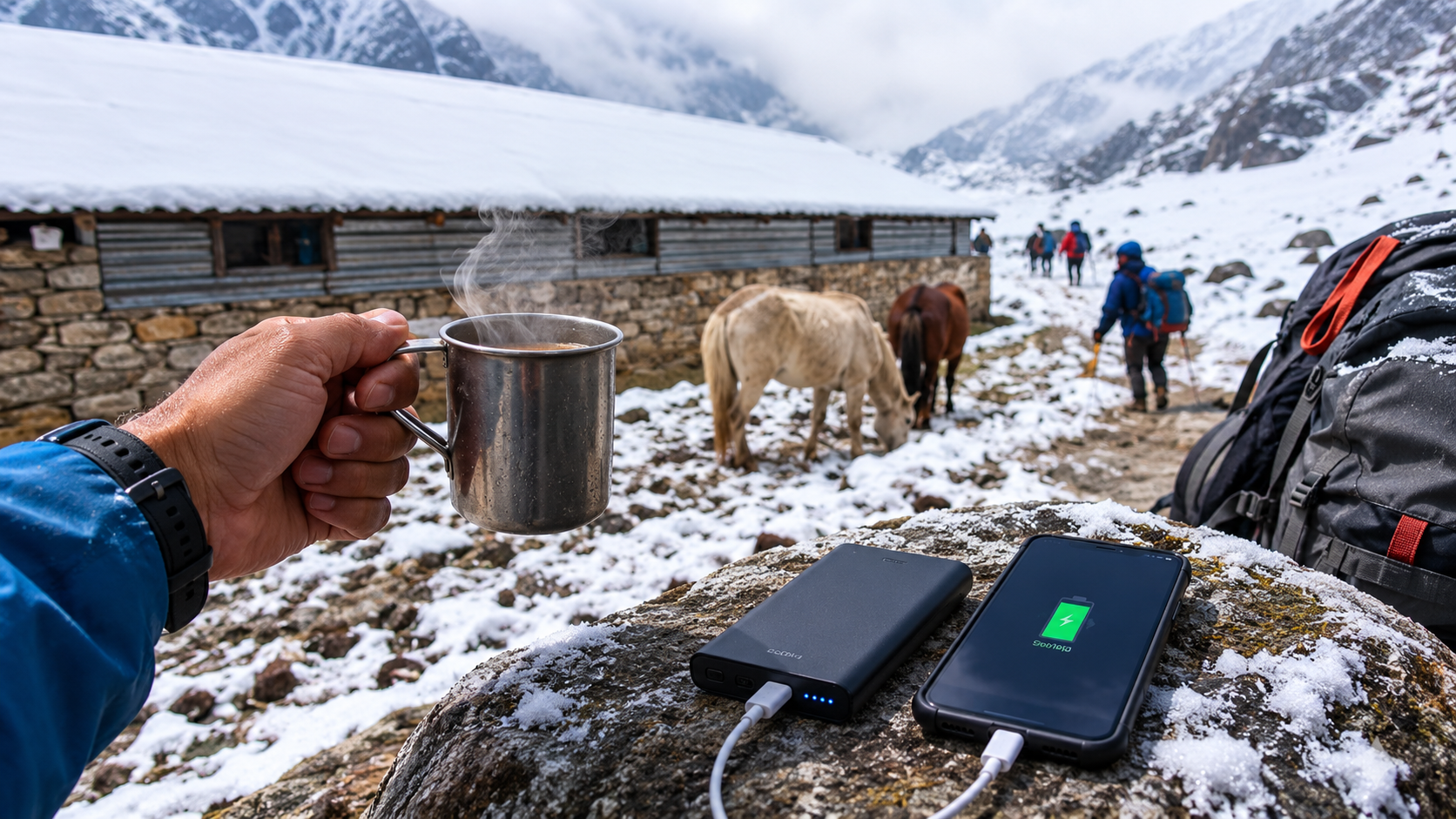
No—once you leave the base village of Yuksom, there is no grid electricity or public charging infrastructure along high-altitude Sikkim trekking trails. For the entire duration of multi-day expeditions inside Khangchendzonga National Park, trekkers must be 100% self-sufficient using pre-charged power banks and spare camera batteries.
High-altitude trails in West Sikkim traverse protected forest reserves and glacial valleys where permanent electrical lines do not exist. Whether you are capturing the sunrise over Mt. Pandim from Dzongri Top or shooting Kanchenjunga from Goechala Viewpoint 1, knowing how to manage charging phone camera on Sikkim trek routes prevents dead batteries on summit morning.
1. Power Availability Along Sikkim Trekking Trails
Unlike commercialized routes in parts of Nepal that feature tea houses with paid plug points, trekking in Sikkim is strictly camp-based and wilderness-focused.
- Base Villages (Yuksom, Uttarey, Lachen): Standard 220V AC wall sockets are available at homestays and hotels. Power cuts can occur in rural West Sikkim, so plug in your devices the moment you check in.
- Lower Forest Camps (Sachen, Tshoka): These campsites sit inside protected national park boundaries. Forest huts and basic wooden trekkers’ huts run on minimal off-grid solar lighting reserved strictly for staff and emergency use—not trekker electronics.
- High-Altitude Camps (Dzongri, Kokchurang, Thansing, Lamuney): Zero electricity. You are sleeping in alpine tents at elevations between 3,650 m and 4,200 m where temperatures drop well below freezing.
| Trek Zone | Altitude Range | Grid Electricity | Charging Reality |
| Yuksom (Base) | 1,780 m | Yes (220V AC) | Last reliable wall socket before entering the park |
| Sachen & Tshoka | 2,180 m – 2,950 m | None | Rely entirely on your carried power banks |
| Dzongri & Thansing | 3,930 m – 4,020 m | None | Sub-zero nights accelerate battery drain |
| Lamuney & Goechala | 4,150 m – 4,650 m | None | Pre-dawn summit push; keep devices warm against your body |
2. Power Banks & Battery Sizing for Sikkim Expeditions
Because charging phone camera on Sikkim trek routes depends entirely on what you carry on your back, calculating your watt-hour needs before leaving Siliguri or NJP is essential.
Recommended Capacity by Trek Duration
- Short & Moderate Treks (5–7 Days — e.g., Dzongri Trek Package): Carry one 20,000 mAh power bank (approx. 74 Wh) with Power Delivery (PD) fast charging. This provides 3.5 to 4 full smartphone charges and tops up a headlamp or smartwatch.
- Long High-Altitude Treks (9–11 Days — e.g., Goechala Trek Package): Carry two 20,000 mAh power banks or one 20,000 mAh + one 10,000 mAh unit. Having two separate units protects you from single-point failure if one port gets damp or malfunctions.
Camera & Action Cam Battery Rules
- Mirrorless & DSLR Cameras: Lithium-ion camera batteries lose 30% to 40% of their effective capacity at 4,000 m. Pack at least 3 to 4 fully charged camera batteries for a week-long trail.
- GoPro / Action Cameras: Small action-camera cells shut down rapidly in wind chill. Carry 3 to 4 Enduro/cold-rated batteries rather than relying on USB charging inside a tent.
- Aviation Compliance: If flying into Bagdogra (IXB), keep all power banks and loose lithium batteries in your cabin carry-on luggage. Indian aviation rules prohibit lithium batteries in checked baggage and cap individual power banks at 100 Wh (approx. 27,000 mAh).
Do Portable Solar Chargers Work in Sikkim?
Foldable solar panels (20W–28W) have limited reliability in Sikkim compared to arid regions like Ladakh. Thick rhododendron canopies below 3,500 m block direct sunlight, and afternoon cloud cover rolls in quickly across Kanchenjunga National Park. Treat a solar panel only as a trickle-charge backup strapped to your daypack, never as your primary power source.
3. Cold-Weather Battery Care at High Altitude
Lithium-ion batteries rely on chemical reactions that slow down drastically when temperatures drop below 0°C—a nightly reality at Dzongri, Thansing, and Lamuney. A phone showing 60% charge inside a warm dining tent can plummet to 5% within ten minutes of exposure to freezing summit winds.
- Sleep With Your Electronics: Every night at camp, place your phone, power banks, and spare camera batteries inside a dry ziplock pouch and tuck them into the bottom of your sleeping bag. Your body heat keeps the lithium cells active.
- Use Inside-Layer Pockets While Walking: Keep your phone and spare batteries in an inner fleece or down jacket pocket rather than an outer backpack lid.
- Switch to Airplane Mode Immediately After Yuksom: Cellular reception disappears shortly after leaving Yuksom (with occasional weak signals near Tshoka). Leaving mobile data and network search active drains up to 40% of your battery daily while scanning for non-existent towers.
- Dim Screen Brightness & Use Optical Viewfinders: Cold LCD screens draw heavy current. Use your camera’s electronic or optical viewfinder instead of reviewing photos on the rear screen, and disable Bluetooth/Wi-Fi file transfers.
- Warm a “Dead” Battery Before Swapping: If your camera shuts off in the freezing pre-dawn push to Goechala Viewpoint 1, warm the battery in your palm or inner pocket for 5 minutes—it will often regain enough voltage for another 20–30 shots.
4. Responsible Charging Expectations & Trail Etiquette
Sikkim enforces some of India’s strictest eco-tourism regulations inside Kanchenjunga National Park. Understanding responsible charging expectations keeps group logistics smooth and protects fragile alpine ecosystems:
- Never Ask Kitchen Staff to Charge Personal Devices: Trekking support teams carry small solar lanterns or limited fuel strictly for camp kitchen safety and emergency satellite/radio communication. Kitchen tents are not charging stations.
- Respect Fellow Trekkers’ Power Reserves: Do not assume you can borrow a teammate’s power bank mid-trek. Everyone budgets their milliamp-hours for their own safety and photography.
- Pack Out Damaged Batteries & Cables: Never discard swollen batteries, frayed cables, or packaging at campsites. Carry all electronic waste back to Yuksom and Siliguri for proper disposal.
- Prioritize Safety Devices Over Social Media: Reserve at least 20% of one power bank strictly for emergency navigation, offline maps, or your trek leader’s communication needs.
Frequently Asked Questions (FAQ)
Can I charge my phone at campsites on the Goechala or Dzongri trek?
No. There are no electrical outlets or public charging points at Sachen, Tshoka, Dzongri, Kokchurang, Thansing, or Lamuney. Your last reliable wall charging point is your hotel or homestay in Yuksom before the trek begins.
How many power banks do I need for a 10-day Sikkim trek?
For an 8-to-10-day expedition like Goechala, carry two 20,000 mAh power banks. If you keep your phone on Airplane Mode and store power banks inside your sleeping bag at night, 40,000 mAh total capacity comfortably covers a smartphone, headlamp, and smartwatch.
Why does my phone battery die so fast in Sikkim even when I am not using it?
Two factors cause rapid drain: sub-zero temperatures slow down lithium-ion chemistry, and leaving cellular reception turned on forces your phone’s antenna to boost power continuously while searching for signal in dead zones.
Are solar power banks allowed and effective in Kanchenjunga National Park?
Yes, portable solar chargers are permitted, though dense forest cover at lower camps and unpredictable afternoon mountain clouds limit their output. Use them only as a supplementary top-up alongside standard pre-charged lithium power banks.
Should I carry a multi-port wall charger for Yuksom?
Yes. Homestays in Yuksom often have only one or two wall sockets per room. Carrying a compact multi-port GaN charger (with 2 USB-C and 1 USB-A port) lets you recharge your phone, power banks, and camera battery charger simultaneously overnight before starting the trail.
Why Choose Us for Your Sikkim Trek?
- Local Sikkim Operations Base: Headquartered in West Sikkim with permanent ground logistics in Yuksom, ensuring seamless pre-trek briefings, gear checks, and reliable homestay stays with verified power access before you hit the trail.
- Certified High-Altitude Leaders: Led by NIM/HMI-certified local mountaineering guides trained in wilderness first aid, AMS protocols, and off-grid expedition management.
- Zero-Trace Eco Commitment: Strict adherence to Kanchenjunga National Park conservation guidelines, solar-lit base operations, and responsible waste-management practices.
- Small Batch Sizes: Capped at 12 trekkers per batch for personalized safety monitoring, unhurried photography windows, and attentive camp support.
Featured Sikkim Trek Packages
Planning your battery and gear setup is easier when your itinerary is structured for proper acclimatization. Explore our flagship West Sikkim departures:
| Trek Package | Duration | Max Altitude | Difficulty | Starting Price (Ex-Yuksom) |
| Dzongri Top Trek | 7 Days / 6 Nights | 4,200 m (13,780 ft) | Moderate | ₹24,000 per person |
| Goechala Trek Package | 10 Days / 9 Nights | 4,650 m (15,255 ft) | Moderate–Difficult | ₹14,900 per person |
Package Inclusions: Kanchenjunga National Park permits, Yuksom homestay accommodation (Day 1 & final night), all-season alpine tents, sleeping bags rated to -10°C, nutritious vegetarian/egg mountain meals, certified trek leader, and porter/yak support.
Plan Your Sikkim Expedition — Contact Details
Have questions about preparing your camera kit, power bank setup, or batch availability for Spring (March–May) and Autumn (September–December)? Reach out directly to Glacier Treks and Adventure:
- Trekking Agency Name: Glacier Treks and Adventure
- Phone / WhatsApp: +91 74072 48200
- Base Office Address: Bazaar, near hospital, Yuksom, Sikkim 737113
- Pickup & Connectivity Hub: NJP Railway Station / Bagdogra Airport (IXB)