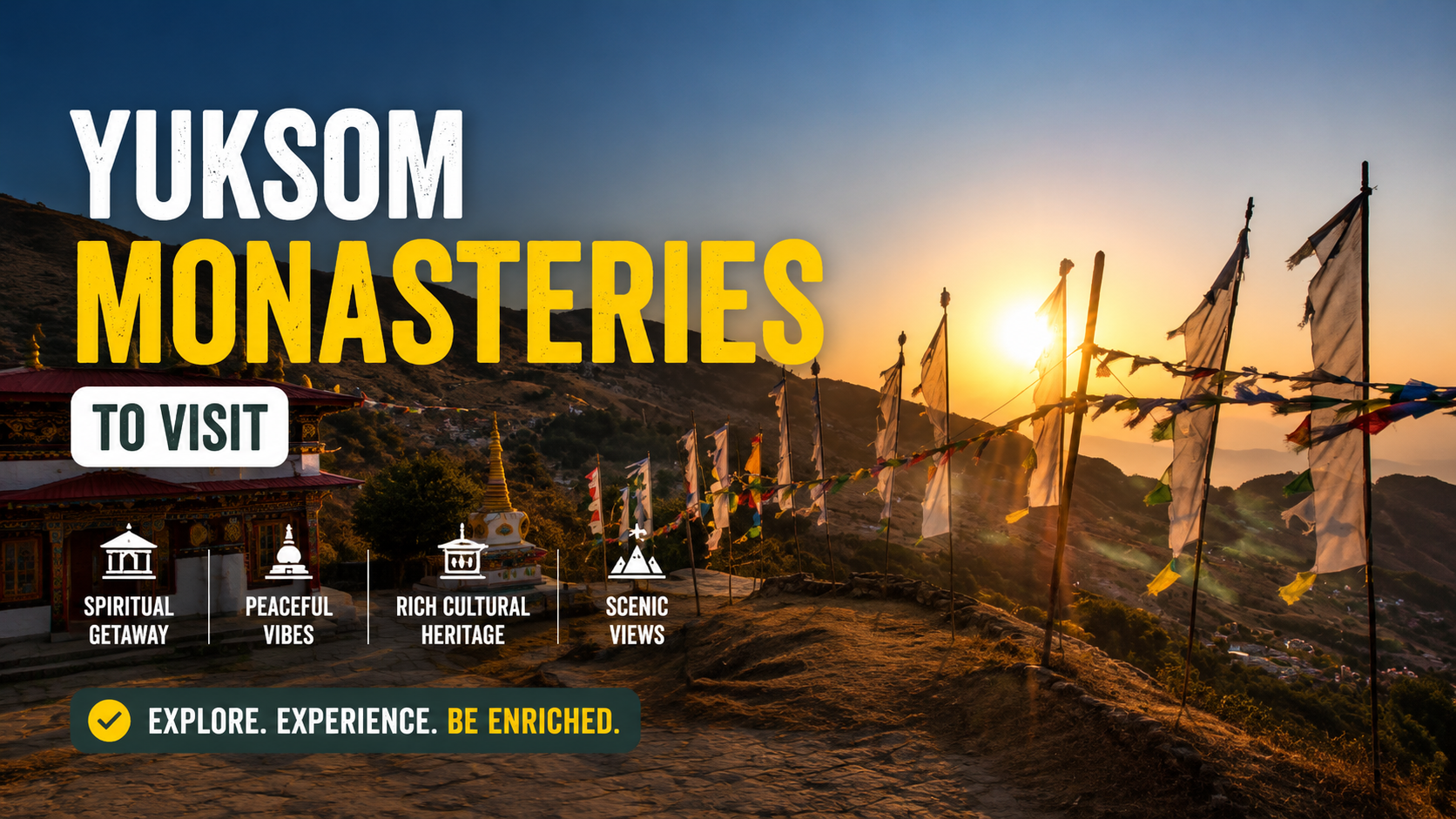
When trekkers arrive in West Sikkim to begin the Goechala Trek, they usually treat the base camp town of Yuksom as a basic overnight logistics hub. They check into their rooms, sort out their backpacks, and focus entirely on the mountain trail ahead. By doing this, they miss out on a deep cultural corridor.
As the first capital of the Buddhist kingdom of Sikkim from 1642 to 1670, Yuksom is a living sacred landscape. The local trails, old-growth forests, and lakes form a spiritual sanctuary walked by lamas for nearly four centuries. Exploring the definitive Yuksom monasteries to visit on your Day-0 afternoon is more than just a sightseeing tour—it is a vital part of your high-altitude acclimatization process.
1. Dubdi Monastery: The Hermit’s Cell
Perched on a high ridge at 2,100 meters directly above the village, Dubdi Monastery is the crown jewel among all the Places to visit in Yuksom. Established in 1701 by Chogyal Phuntsog Namgyal, it holds the historic title of being the oldest monastery in Sikkim. The name ‘Dubdi’ translates to ‘the retreat,’ perfectly reflecting its isolated, peaceful setting.
No vehicles can drive up to the ridge. Reaching the structure requires a rewarding foot journey. The Dubdi monastery trek distance is roughly 1.5 to 2 km. It needs a steady uphill climb along a stone-stepped forest trail. This takes approx 45 minutes to an hour.
The Acclimatization Benefit: Walking the Dubdi monastery trek distance gives you a 320-meter vertical altitude exposure. Climbing from Yuksom’s base level (1,780m) up to the monastery (2,100m) signals your body to start producing red blood cells before your harder trekking days begin.
2. Norbugang Coronation Throne & Kathok Lake
While not an active temple building, the Norbugang coronation throne at Yuksom is culturally inseparable from the local monastic circuit. Located at the western edge of the village, this open-air stone throne is the exact spot where three prominent lamas crowned the first king of Sikkim in 1642, marking the formal birth of the kingdom.
A flat, 15-minute walk from the town center leads you to this peaceful clearing shaded by an ancient pine tree. Directly adjacent lies Kathok Lake, one of the seventeen highly sacred lakes of Sikkim. The lamas used their water for the original coronation ceremonies. Together, these sites form a gentle, one-hour evening walking loop that is perfect for loosening up stiff legs after a long drive from Siliguri or NJP.
3. Extending Your Spiritual Circuit in West Sikkim
If you have an extra buffer day built into your travel itinerary, you can easily explore the wider regional landmarks that directly connect to Yuksom’s ancient history.
Pemayangtse Monastery
Located roughly an hour’s drive away near Pelling, Pemayangtse Monastery, West Sikkim, is one of the most prestigious spiritual centers in the state. Historically, the head lamas of Pemayangtse held the exclusive right to perform the coronation ceremonies for the kings of Yuksom. Visiting Pemayangtse monastery, West Sikkim, on your way to the base camp gives you a brilliant look at antique Buddhist artwork and a famous seven-tiered wooden model of Guru Rinpoche’s celestial palace.
Read more: Find accommodation near the Goechala trailhead with our Yuksom hotel guide
Quick Reference: Yuksom Heritage Sites Comparison
| Sacred Site | Location / Distance from Center | Required Travel Time | Best Used For |
| Dubdi Monastery | 2 km uphill trail (forest walk) | 1.5 Hours (Round trip) | Oldest monastery in Sikkim; ideal for Day-0 altitude acclimatization. |
| Norbugang Throne | Edge of Yuksom Village (Flat walk) | 30 Minutes (Round trip) | Historical exploration; gentle afternoon leg-stretcher. |
| Kathok Lake | Next to Norbugang Site | 40 Minutes (With loop) | Photography; quiet contemplation by the boardwalk. |
| Pemayangtse | ~40 km away near Pelling (Drive) | Half-Day Excursion | Circuit expansion: breaking up the long drive to the base camp. |
Read More: Plan your complete Yuksom trip with our detailed travel guide (routes, permits, transport, and tips)
Frequently Asked Questions (FAQ)
Q1: What are the main Yuksom monasteries to visit for travelers?
The most important sites are the Dubdi Monastery (located on the ridge above town) and the historical Norbugang coronation throne, Yuksom compound. Both locations hold incredible spiritual significance and are easily accessible on foot from any local hotel or homestay.
Q2: Is the trail for the Dubdi monastery trek distance safe for beginners?
Yes, the path is a well-laid stone stairway that winds gently through a thick canopy of trees. While it is steadily uphill, it requires no technical climbing experience. Walking slowly and carrying a water bottle makes it accessible to travelers of all fitness levels.
Q3: What makes Dubdi the Oldest Monastery in Sikkim?
Dubdi was founded in 1701 during the early reign of the Namgyal dynasty. It is recognized by historians and archeologists as the earliest functional monastic structure built in the state that is still standing today.
Ready to Start Your Goechala Trek from Yuksom?
Yuksom is more than the starting point on a map. It is a 17th-century Buddhist capital, the home village of the team that will guide your trek, and a place worth spending more time in than most trekkers do. If you are planning your 2026 Goechala Trek, build in an extra Yuksom day if you can — and reach out to us for any local questions that this guide has not answered. The office is open six days a week, and walk-ins are welcome.
Visit or book: Yuksom Bazar Main Road, near Hotel Yangri Gang · Call/WhatsApp +91 7407248200 · Email contact@trekinsikkim.in
Read more: Read the complete Goechala Trek guide (itinerary, cost, difficulty, packing)
Read more: Discover the best places to stay in Yuksom before and after your trek
Read more: Browse all our treks and tours from Yuksom
Read more: Book the Goechala Trek online
About the author
Kiran Gurung is the founder of Glacier Treks & Adventure and a long-time resident of Yuksom, West Sikkim. Born in a remote Sikkimese village, he has spent his entire adult life operating treks and expeditions from the Yuksom trailhead. An IMF-certified mountaineer, he has personally led more than 200 Goechala expeditions and is a founding member of the Yuksom Tourism Development Committee (YTDC). His office on Yuksom Bazar Main Road has been the starting point for over 12,000 trekkers across fifteen seasons.