The Dzongri Trek is a 7-day, 58-kilometre Himalayan trek in West Sikkim that climbs to Dzongri Top at 4,200 metres — one of the closest viewpoints in India for sunrise on Mt Kanchenjunga. It is essentially the first half of the longer Goechala Trek, starting and ending at Yuksom, and is the best Himalayan trek you can do inside a single week’s leave from work. The Dzongri Trek cost in 2026 is ₹14,900 per person (₹15,999 list price) for Indians and $250 for international trekkers. Best months: March–May and September–December. Difficulty: Moderate. Suitable for ages 10 to 65.
The Dzongri Trek is the trek I recommend most often to two very specific people: the experienced trekker who has only seven days of leave and wants a real high-altitude Himalayan summit in that window, and the strong beginner who is not quite ready for the ten-day commitment of Goechala but wants more than a teahouse trek. For both, Dzongri delivers something extraordinary — the same sunrise on Kanchenjunga that the Goechala trekkers walk three extra days to see, from a viewpoint that is genuinely up there with the great Himalayan mornings.
I have run the Dzongri Trek from our Yuksom base for 15 years. The trail shares the first four days of our Goechala route, then turns back from Dzongri Top instead of pushing on to Goechala Viewpoint 1. That shared geography is the point of this guide. If you are choosing between Dzongri and Goechala — as most trekkers researching this trek are — this article will give you a clear answer, along with the full itinerary, cost, and logistics for 2026.
1. Dzongri Trek Quick Facts
| Attribute | Detail |
|---|---|
| Region | West Sikkim, Kanchenjunga National Park |
| Trail name | Dzongri Trek (also written ‘Dzongri Top Trek’) |
| Start / End point | Yuksom (1,780m) |
| Highest point | Dzongri Top — 4,200m (approximately 13,780 ft) |
| Duration | 6 nights / 7 days from Yuksom; add transfer days if travelling from NJP/Bagdogra |
| Trek distance | Approximately 58 kilometres total |
| Difficulty | Moderate |
| Best time | March–May (spring) and September–December (autumn) |
| Suitable age | 10 to 65 years |
| Cost (Indian) | ₹14,900 per person (₹15,999 list price) |
| Cost (Foreign) | $250 per person |
| Permits needed | Kanchenjunga National Park entry, trekking route permit, Yuksom police registration |
| Mountain views | Kanchenjunga (8,586m), Pandim, Kabru, Frey, Rathong, Black Kabru |
| Mobile network | BSNL/Jio until Yuksom and Tshoka; no signal from Day 3 onwards |
2. Where Is Dzongri and Why Is It Special
Dzongri is a high alpine meadow at 4,030 metres in the Kanchenjunga National Park, with the Dzongri Top viewpoint sitting a steep two-kilometre climb above it at 4,200 metres. The trail begins at Yuksom — the first capital of Sikkim from 1642 — and follows the Rathong river valley west through Sachen, Bakhim and Tshoka before climbing into the treeline at Phedang and breaking into the open alpine zone of the Dzongri plateau.
What makes Dzongri genuinely special, in my experience, is three things that no other 7-day Sikkim trek can match:
- The closest Kanchenjunga sunrise you can get in seven days. Dzongri Top puts you within thirty kilometres of the Kanchenjunga summit, with no intervening ridges. The face that lights up at sunrise is the same face Goechala trekkers see — you simply do not get to walk under it.
- Five distinct ecosystems in five days. Subtropical broadleaf forest at 1,780m, temperate oak-rhododendron at 2,800m, silver-fir conifer at 3,500m, alpine meadow at 4,000m. The transitions happen quickly and visibly — it is a textbook ecological gradient compressed into less than a week.
- Rhododendron forest depth. The Tshoka-to-Phedang section in April and May is one of the densest rhododendron belts in the Indian Himalaya. Seven distinct species, three colours, and a forest floor that is essentially carpeted with fallen blooms.
Read more: Starting from Yuksom — the trailhead guide
3. Dzongri Trek Itinerary — Day by Day
The standard Dzongri Trek itinerary is 6 nights and 7 days from Yuksom, with one or two contingency days that we use at Tshoka or Dzongri if any trekker shows altitude symptoms. The trek shares its first four days with our Goechala Trek route — meaning the same trail, same campsites, same support team — and then turns back from Dzongri Top instead of continuing to Thangsing and Lamuney.
Day 1 — Arrival at NJP / Bagdogra, transfer to Yuksom
Distance: 150km by road. Travel time: 6–7 hours. Altitude: Yuksom 1,780m.
You arrive at NJP by overnight train or Bagdogra by morning flight. Our shared vehicle picks up between 9 AM and 11 AM and reaches Yuksom by evening. The road climbs through Jorethang and Pelling before dropping into the Yuksom basin. On arrival, you will be settled into a guesthouse, briefed on the trek, and given a final gear check. Spend the evening walking up to Norbugang or Kathok Lake — light altitude exposure helps acclimatisation.
Day 2 — Yuksom to Sachen
Distance: 8km. Walking time: 5–6 hours. Altitude: 1,780m → 2,160m.
The first real trekking day. You leave Yuksom through farmland, drop down to the Prek Chu, and cross suspension bridges over the Phamrong and Tshushay rivers. The forest is mixed broadleaf — oak, magnolia, alder, with the first rhododendrons appearing higher up. The grade is gentle but the day is not short. Sachen is a small forest camp on a clearing with basic tented accommodation.
Day 3 — Sachen to Tshoka via Bakhim
Distance: 7–8km. Walking time: 4–6 hours. Altitude: Tshoka 2,950m.
The trail climbs steadily to Bakhim (2,740m) where there is a trekkers’ hut and the first proper view of the surrounding ridges. From Bakhim, another two kilometres of forest brings you to Tshoka — a small village of ten houses on a clearing facing Mt Pandim. In April and May the surrounding rhododendron forest is one of the most photographed sections of any Sikkim trek.
Day 4 — Tshoka to Dzongri via Phedang
Distance: 8–9km. Walking time: 6–7 hours. Altitude: Dzongri 4,030m.
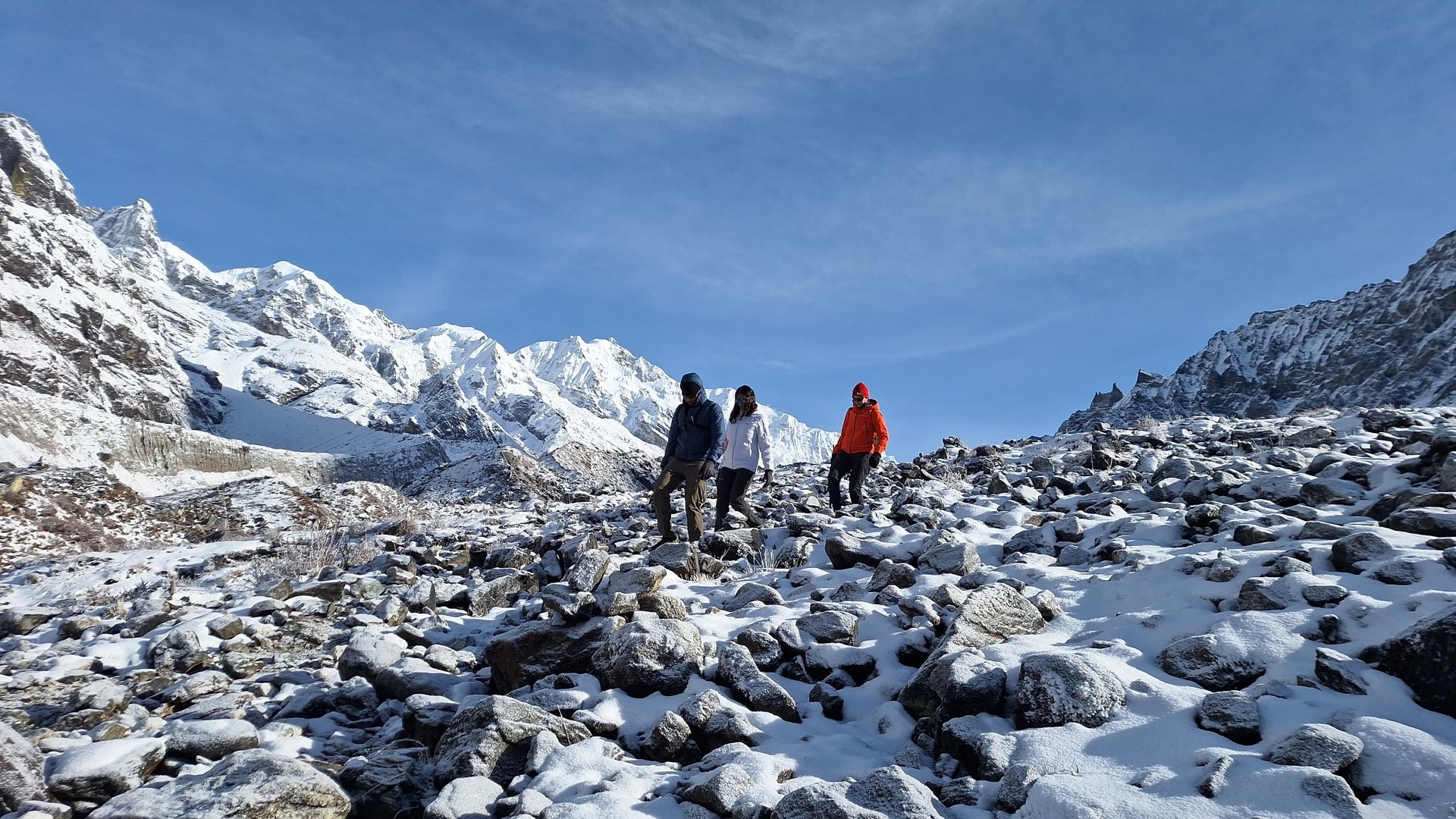
This is the hardest day of the trek. The trail climbs through deep rhododendron forest to Phedang at 3,650m, breaks above the treeline, and traverses open alpine meadow to Dzongri. The altitude gain is significant — roughly 1,080m in one day, which is at the edge of acclimatisation safety. We move slowly, take a long lunch at Phedang, and reach Dzongri by mid-afternoon. Many trekkers feel the first mild symptoms of altitude here. This is normal and manageable if you drink water and eat properly.
If we have any concern about a trekker’s acclimatisation on Day 4, we use a contingency day at Dzongri for a short walk to Dzongri Top and back. The day is built into our package — we do not charge extra for it and we do not skip it to save time.
Day 5 — Dzongri to Dzongri Top sunrise + acclimatisation
Distance: 2km round trip from camp. Walking time: 3–4 hours. Altitude: 4,030m → 4,200m.
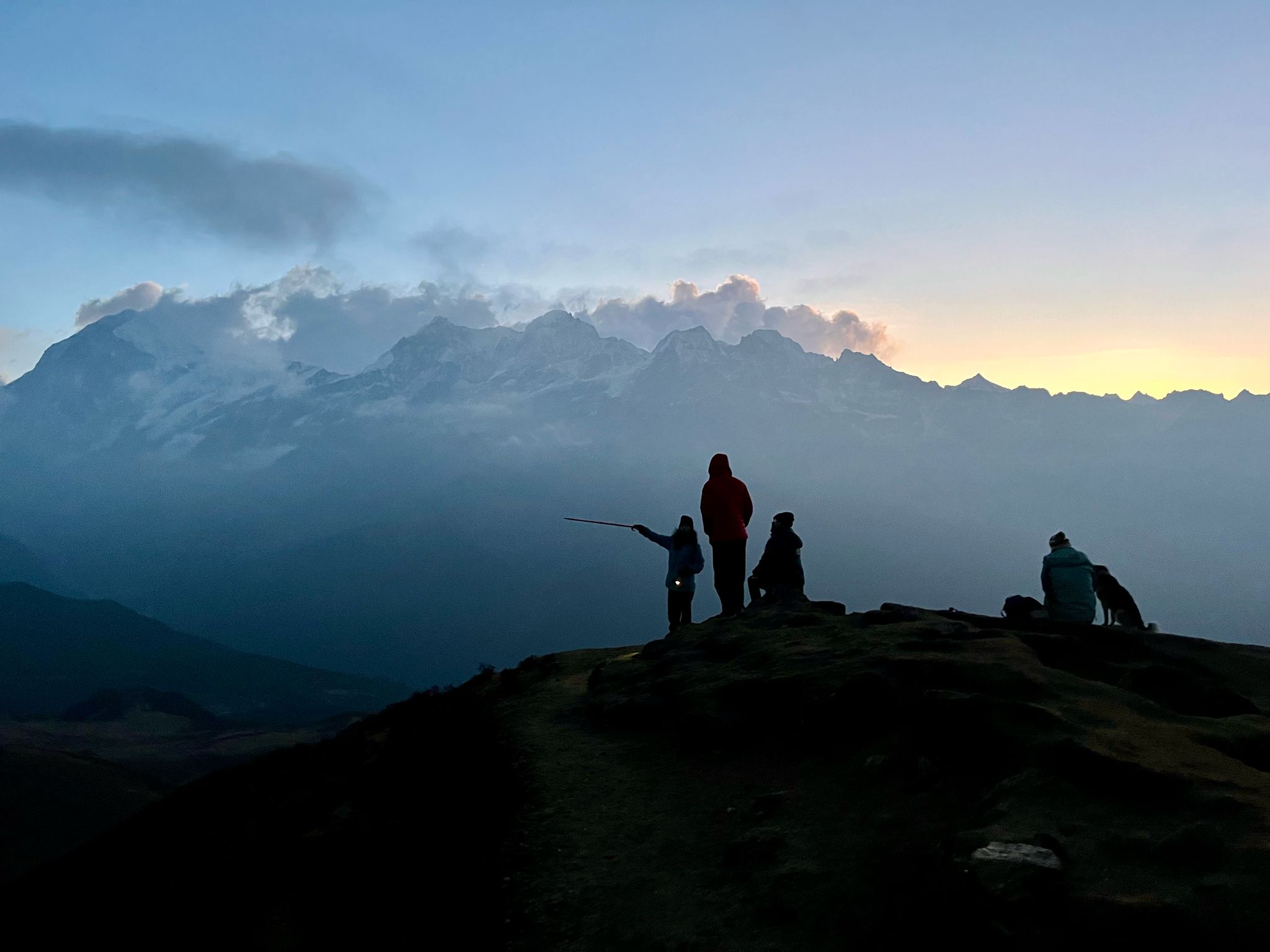
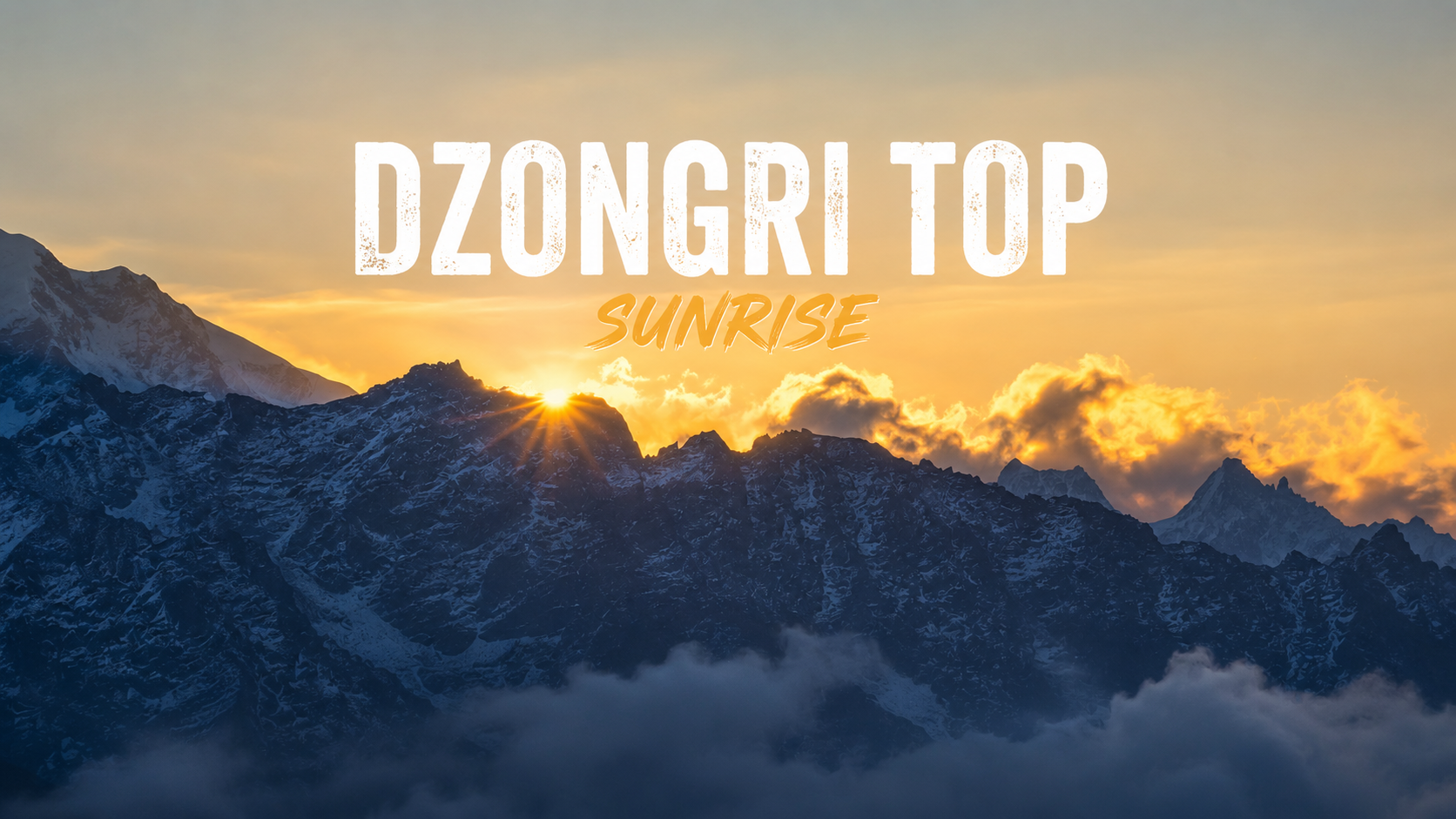
Wake-up is at 3:30 AM. We leave camp by 4:00 AM with headlamps for the steep climb to Dzongri Top. The path zigzags up a frozen ridge — slow, deliberate, one breath per step at altitude. We reach the viewpoint just before sunrise. Within twelve minutes, Kanchenjunga, Pandim, Kabru, Rathong, Frey and Black Kabru all light up in sequence — first pink, then orange, then full golden. The view from Dzongri Top is, in my honest opinion, one of the three or four best mountain sunrises in the Indian Himalaya.
After sunrise, we descend back to Dzongri camp for breakfast. The rest of the day is rest and active acclimatisation — short walks around the meadow, hydration, an early dinner. This day is also why Dzongri works as a 7-day trek: it builds the altitude buffer that lets the body adjust to 4,200m before the descent.
Day 6 — Dzongri to Tshoka
Distance: ~6km. Walking time: 4–5 hours. Altitude: 4,030m → 2,950m.
A long descent through Phedang and back into the rhododendron forest. The breathing gets easier with every hundred metres of altitude lost. Tshoka in the evening feels almost tropical compared to the bare alpine world above Phedang — a contrast that is one of the rewards of this trek.
Day 7 — Tshoka to Yuksom
Distance: 13–15km. Walking time: 6–7 hours. Altitude: 2,950m → 1,780m.
The final trekking day. A long, steady descent through Bakhim, Sachen and back into the Prek Chu valley, returning to Yuksom by late afternoon. We organise a celebration dinner at our base in Yuksom for every group on this evening.
Day 8 — Yuksom to NJP / Bagdogra
Early morning departure by shared vehicle. We typically reach Bagdogra airport by 3 PM and NJP by 4 PM. Keep your flight or train booking after 5 PM to be safe.
Read more: Best Dzongri Sunrise View: You will Love this.
4. Dzongri Trek Cost in 2026 (Full Breakdown)
Our 2026 Dzongri Trek package is priced at ₹14,900 per person for Indian trekkers (discounted from a list price of ₹15,999) and $250 for international trekkers. Below is the full breakdown of what is included and the realistic extras.
| Cost head | Indian trekkers (INR) | Foreign trekkers (USD) |
|---|---|---|
| Standard package (Yuksom to Yuksom) | ₹14,900 | $250 |
| List price (before seasonal discount) | ₹15,999 | $280 |
| Kanchenjunga National Park permit (Indian) | Included | Extra at the check post |
| NJP/Bagdogra to Yuksom transfer (shared, per head) | ₹3,200 | $50 |
| Bag offloading (mule/yak, full trek) | ₹4,500 | On request |
| Gear rental (jacket, sleeping bag, poles) | ₹2,500 (full set) | $40 |
| GST (mandatory) | 5% | 5% |
| Travel & medical insurance (mandatory) | ~₹800 | Trekker’s own |
| Tips for support team (suggested, per trekker) | ₹400–800 | $10–12 |
What is included: all meals from Day 1 dinner to Day 7 breakfast, twin-share tented or trekkers’ hut accommodation throughout, twin-share guesthouse stay in Yuksom on arrival and the final night, IMF-certified trek leader, local Sikkimese guide, cook and helpers, mules to carry kitchen and camping equipment, basic medical kit with portable oxygen, all Kanchenjunga National Park entry fees (Indian rate), Yuksom police registration, contingency acclimatisation day at Dzongri.
What is not included: transport between NJP/Bagdogra and Yuksom, personal trekking gear, personal medical insurance, GST of 5%, tips, and anything not specifically listed in the inclusions.
A realistic all-in budget for an Indian trekker arriving at NJP and departing from NJP works out to roughly ₹22,000–25,000 — that is the ₹14,900 package + 5% GST + ₹3,200 transfer + optional offloading + insurance + tips. For foreign trekkers, the equivalent is around $360–420 all-in. Add your own flights or trains separately.
Read more: Detailed Dzongri Trek cost breakdown for Indian and foreign trekkers
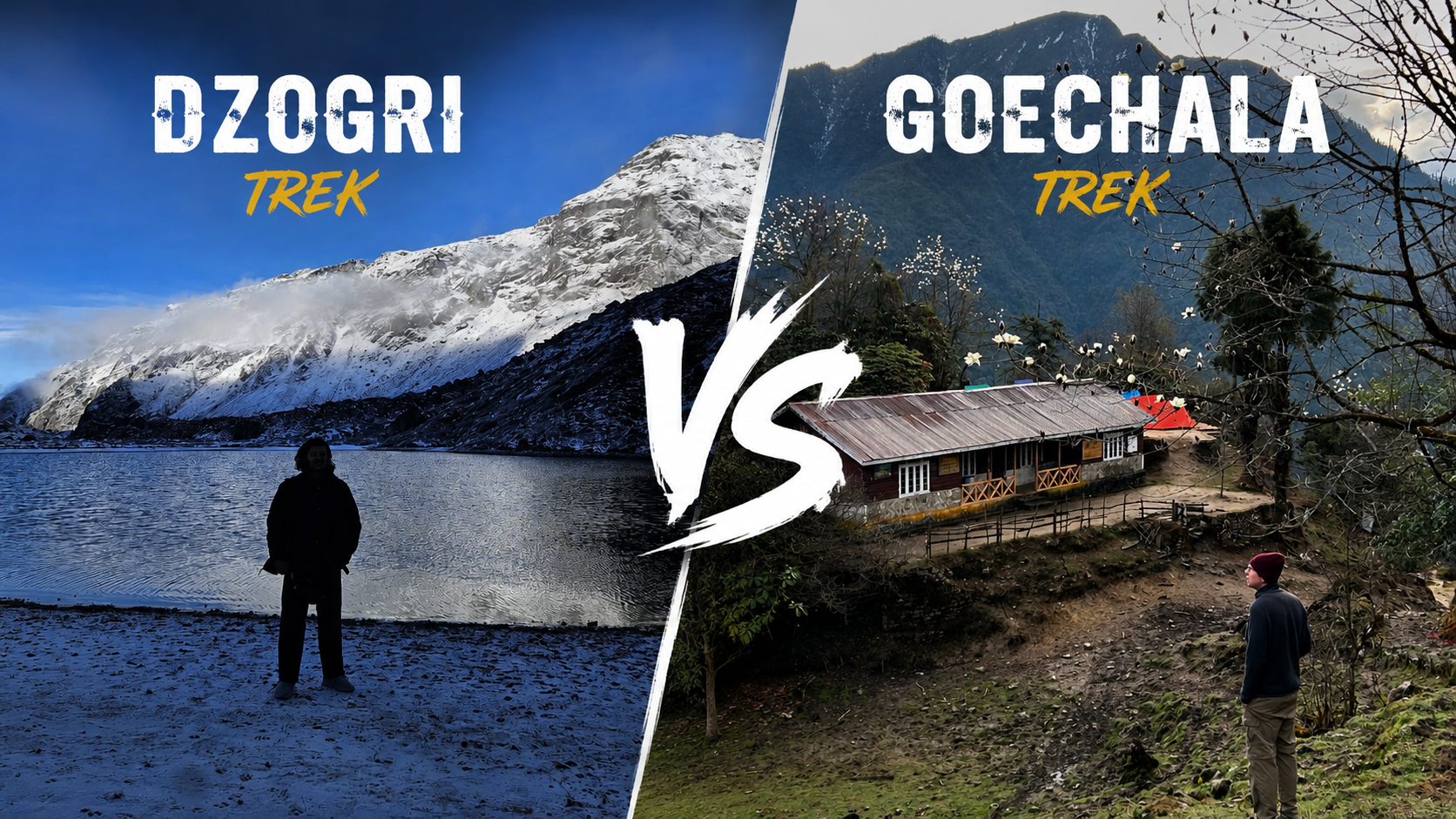
5. Dzongri vs Goechala — Which Trek Should You Choose
This is the most-searched question about the Dzongri Trek — and rightly so. The two routes share the same trailhead, the same first four days, the same support team and the same operator. The difference is whether you turn back from Dzongri Top on Day 5, or continue to Goechala Viewpoint 1 on Day 7. Here is how they genuinely compare:
| Factor | Dzongri Trek | Goechala Trek |
|---|---|---|
| Duration | 6N / 7D | 9N / 10D |
| Highest altitude | 4,200m (Dzongri Top) | 4,500m (Goechala Viewpoint 1) |
| Distance | 58 km | 80 km |
| Difficulty | Moderate | Moderate to Difficult |
| Cost (Indian) | ₹14,900 | ₹19,500 |
| Kanchenjunga proximity | 30 km from summit | 15 km from summit |
| Mountain view | Sunrise on full massif from Dzongri Top | Full south face of Kanchenjunga at close range |
| Camping nights above 4,000m | 1 (at Dzongri) | 3 (Dzongri, Thangsing, Lamuney) |
| Best for | Trekkers with 7 days, strong beginners | Trekkers with 10 days, intermediate fitness |
| Repeat trekkers do this when… | Time-constrained or as second trek | Lifetime Himalayan trip |
Plain advice: if you have ten days and reasonable fitness, do Goechala trek with our full guidance. The walk from Dzongri to Goechala Viewpoint 1 takes you under the mountain rather than just looking at it from a distance, and the difference is the difference. If you have seven days, do Dzongri without hesitation — the Dzongri Top sunrise alone is reason enough, and you are still getting an alpine summit at 4,200m with a real high-altitude trekking experience. If you have nine days, do Goechala — the extra two days make a meaningful difference.
Read more: Full Dzongri vs Goechala head-to-head comparison
Read more: If you have 10 days: read the full Goechala Trek guide
6. Best Time to Do the Dzongri Trek
Dzongri has two clear trekking windows: spring (March to May) and autumn (September to December). Avoid the monsoon months of June, July and August — the trail is leech-infested, slopes are landslide-prone, and Kanchenjunga is hidden behind clouds for weeks at a time.
| Month | Weather | Visibility | Crowds | Recommended for |
|---|---|---|---|---|
| March | Cold mornings, mild days | Excellent | Light | First-time Dzongri trekkers |
| April | Mild, rhododendron peak | Very good | High | Photographers, flower lovers |
| May | Warmer, occasional pre-monsoon clouds | Good | High | Wildflower season |
| June–Aug | Monsoon (closed) | Very poor | — | Do NOT trek |
| September | Post-monsoon, fresh | Very good | Light | Quiet trekkers |
| October | Crisp, clear skies | Excellent | Very high | Anyone — peak season |
| November | Cold mornings, clear skies | Excellent | Moderate | Photographers, repeat trekkers |
| December | Cold (-8°C nights), snow possible | Crystal clear | Light | Well-equipped strong trekkers |
If you can only do one window, I recommend mid-October to mid-November. The monsoon has cleared, the autumn light is at its most consistent of the year, and the daytime walking conditions are dry and stable. We have run forty-plus Dzongri batches across this window in the last decade and missed the Dzongri Top sunrise only twice.
Read more: Spring vs Autumn vs Winter Dzongri Trek comparison
7. Dzongri Trek Difficulty and Fitness
Dzongri is rated Moderate on the Indian Himalayan trekking scale. It is more demanding than Sandakphu but considerably less demanding than Goechala. The challenge is altitude rather than distance — you reach 4,200m on Day 5, which is high enough that anyone, regardless of fitness, can develop mild altitude symptoms.
What makes Dzongri demanding
- Day 4 altitude gain of approximately 1,080m from Tshoka to Dzongri — at the edge of safe acclimatisation
- Pre-dawn summit walk at 4,200m with temperatures often below -5°C
- Total distance of 58km over five trekking days
- Camping at 4,030m for two nights
Recommended 6–8 week fitness routine
| Week | Cardio | Strength | Endurance benchmark |
|---|---|---|---|
| 1–2 | Walk 5km in 50 min, 4 days/week | Bodyweight squats, planks, lunges (20 min, 3 days/week) | — |
| 3–4 | Jog/walk 7km in 70 min, 4 days/week | Add stair climbs with a 5kg backpack | 5km hill walk in <60 min |
| 5–6 | Run 8km in 60 min, 4 days/week | Loaded squats (8kg), step-ups, calf raises | 10km hill walk in <2 hr |
| 7–8 | Run 10km in 75 min OR cycle 25km | Maintain a strength routine | 10km with 8kg pack in <2 hr |
If you cannot complete the Week 7–8 endurance test two weeks before the trek, please postpone. Dzongri is forgiving up to a point — but Day 4 will find any gap in your preparation.
8. Dzongri Trek Packing List
Pack for cold, wind, rain and altitude. The temperature range from midday Yuksom to pre-dawn Dzongri Top can span thirty degrees Celsius. Anything marked ‘rentable in Yuksom’ can be hired from our base on Day 1.
Essential clothing
- Thermal base layer: 1 top + 1 bottom (merino or synthetic)
- Mid layer: 1 fleece jacket + 1 light down jacket (rentable in Yuksom)
- Outer shell: 1 waterproof and windproof jacket + 1 waterproof trouser
- Trekking pants: 2 pairs (quick-dry, not denim or cotton)
- T-shirts: 3 dri-fit, full sleeve preferred
- Socks: 4 pairs (2 thick woollen + 2 trekking)
Footwear and accessories
- Trekking shoes: ankle-high, waterproof, broken in (not brand new)
- Slippers for evening camp
- Woollen cap, sun cap, balaclava for summit morning
- Sunglasses: UV-400, category 3 or higher
- Gloves: 1 fleece inner + 1 waterproof outer
- Trekking poles: 1 pair (rentable in Yuksom)
- Headlamp with extra batteries — essential for Dzongri Top morning
Gear and miscellaneous
- Backpack: 50–60 litres with rain cover (or 25-litre day pack if you offload)
- Sleeping bag: rated to -10°C (rentable in Yuksom)
- Water bottles: 2 × 1-litre + small thermos flask
- Personal medical kit: Diamox, paracetamol, ORS, blister patches, your prescriptions
- Toiletries: SPF 50+ sunscreen, lip balm
- Energy snacks: nuts, chocolates, electrolytes
- Documents: original photo ID, 3 photocopies, 6 passport photos, insurance copy
9. Permits and How to Reach Yuksom
Permits required for the Dzongri Trek
Dzongri lies inside Kanchenjunga National Park, and all trekking requires three permissions. We handle the entire process for you, but it helps to know what is being done in your name:
- Kanchenjunga National Park entry permit. Paid at the forest check post in Yuksom on the morning of Day 2. Approximately ₹700 per Indian trekker; significantly higher for foreign trekkers.
- Trekking route permit. Issued by Sikkim Tourism. Required documents: passport-size photo + valid government photo ID.
- Yuksom Police registration. Mandatory entry at the local police station before the trek begins. Three photocopies of your photo ID are needed.
Solo trekking is not permitted inside Kanchenjunga National Park — every trekking party must be accompanied by a registered local guide. We always send an authorised guide with each batch, so this is handled within your package.
How to reach Yuksom
| Mode | Time | Cost (approx) |
|---|---|---|
| Shared jeep — NJP to Yuksom | 7–8 hours | ₹600–800 per seat |
| Private taxi — NJP/Bagdogra to Yuksom | 6–7 hours | ₹6,500–8,500 per vehicle |
| Glacier Treks shared transfer (per head) | 6–7 hours | ₹3,200 |
Most trekkers fly into Bagdogra (IXB) on a morning flight, or arrive at NJP by overnight train, then take a road transfer. We send a shared vehicle that picks up at both NJP and Bagdogra on Day 1 and drops back on Day 8.
Read more: NJP / Bagdogra to Yuksom — full transfer guide
10. Why Trek the Dzongri with Glacier Treks & Adventure
We are based in Yuksom — the actual trailhead for the Dzongri and Goechala treks. Most of the operators advertising Dzongri online are not in Yuksom; they take bookings from Delhi, Bangalore or Gangtok and forward them to a local team in our village. Booking direct with us cuts that commission layer, supports the Yuksom economy directly, and means the people running your trek are the people you spoke to before booking.
In plain numbers:
- 15 years of operating Dzongri and Goechala from Yuksom, founded in 2010
- 150+ guided treks completed across Sikkim, Ladakh and the Indian Himalaya
- 12,000+ trekkers safely brought back home
- Founder Kiran Gurung is an IMF-certified mountaineer and a working trek leader
- Affiliated with the Sikkim Department of Tourism, IMF, TAAS, YTDC and SAMA
- 100% local support team — guides, cooks and porters from the Yuksom valley
- Contingency days are built into every itinerary, not charged extra
11. Frequently Asked Questions
What is the maximum altitude of the Dzongri Trek?
Dzongri Top sits at 4,200m (approximately 13,780 ft) — the highest point reached on the trek. The main Dzongri camp is at 4,030m. Both are below the serious altitude-risk zone of 4,500m+, but high enough that proper acclimatisation matters.
How difficult is the Dzongri Trek?
Moderate. No technical skills are needed — no ropes, ice axes or climbing experience. The challenges are altitude (4,200m), the cumulative effect of five trekking days, and the steep climb to Dzongri Top on summit morning. A reasonably fit beginner who trains for 6–8 weeks beforehand can complete it. An unfit beginner who skips training will struggle on Day 4.
Is the Dzongri Trek good for beginners?
Yes, with one caveat. Dzongri is a recognised ‘first high-altitude trek’ for fit beginners — but it is genuinely high altitude, and the Day 4 climb to 4,030m can catch unfit trekkers off guard. If Dzongri is your first Himalayan trek, do an easier preparation trek (Triund, Kheerganga, or our Bajre Dara Trek) first if possible.
Can I do Dzongri without continuing to Goechala?
Yes — that is the entire point of the Dzongri Trek. You reach Dzongri Top on Day 5 and turn back to Yuksom from there, rather than continuing to Thangsing, Lamuney and Goechala Viewpoint 1. Many of our trekkers who do not have ten days specifically choose this option.
How much does the Dzongri Trek cost in 2026?
Our 2026 package is ₹14,900 per person for Indian trekkers (discounted from ₹15,999) and $250 for international trekkers. A realistic all-in budget including NJP-Yuksom transfers, GST, insurance and tips is ₹22,000–25,000 for Indian trekkers, not counting flights or trains.
Is a mobile network available on the Dzongri Trek?
Patchy BSNL and Jio signal up to Yuksom; weak signal at Tshoka; no mobile network for 5–6 days from Day 3 onwards. Tell your family in advance that you will be unreachable. We carry a satellite communicator for emergencies.
What is the minimum age for the Dzongri Trek?
10 years, accompanied by a parent or guardian. The upper recommended age is 65, with a doctor’s medical clearance for trekkers over 55. We have had healthy 60-year-olds complete Dzongri with no issue — fitness and altitude tolerance matter more than chronological age.
What is the accommodation like on the trek?
Twin-share tents at Sachen, Dzongri and end-route campsites. Trekkers’ huts at Tshoka, with twin or four-share rooms. Twin-share guesthouse rooms at Yuksom on the arrival and final nights. We provide sleeping mats; sleeping bags are rentable in Yuksom on Day 1.
Do I need a guide for the Dzongri Trek?
Yes. Solo and unguided trekking is not permitted inside Kanchenjunga National Park — this is a Sikkim Tourism rule. We always send an authorised local guide with each batch, alongside an IMF-certified trek leader. Both are included in the package price.
Ready to Book Your Dzongri Trek?
The Dzongri Trek is the best high-altitude Sikkim trek you can do in a single week’s leave. The Kanchenjunga sunrise from Dzongri Top is reason enough to come, and the trail through five ecological zones makes the seven days feel like considerably more. Our 2026 season runs from March through May and again from September through December.
Book the Dzongri Trek now: ₹14,900 per person · Call/WhatsApp +91 74072 48200 · Email contact@trekinsikkim.in
Read more: View the Dzongri Trek product page and book online
Read more: Have ten days? Read the full Goechala Trek guide
Read more: Starting from Yuksom — the trailhead guide – Goechala Trek from Yuksom