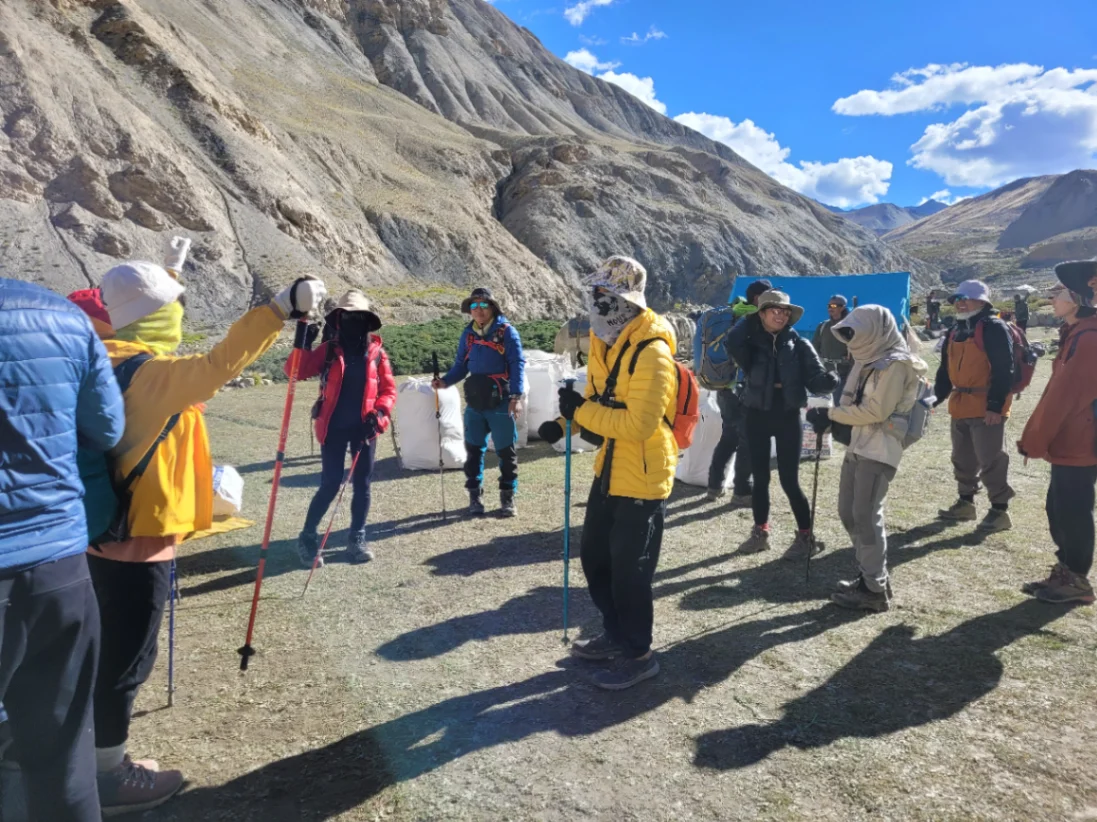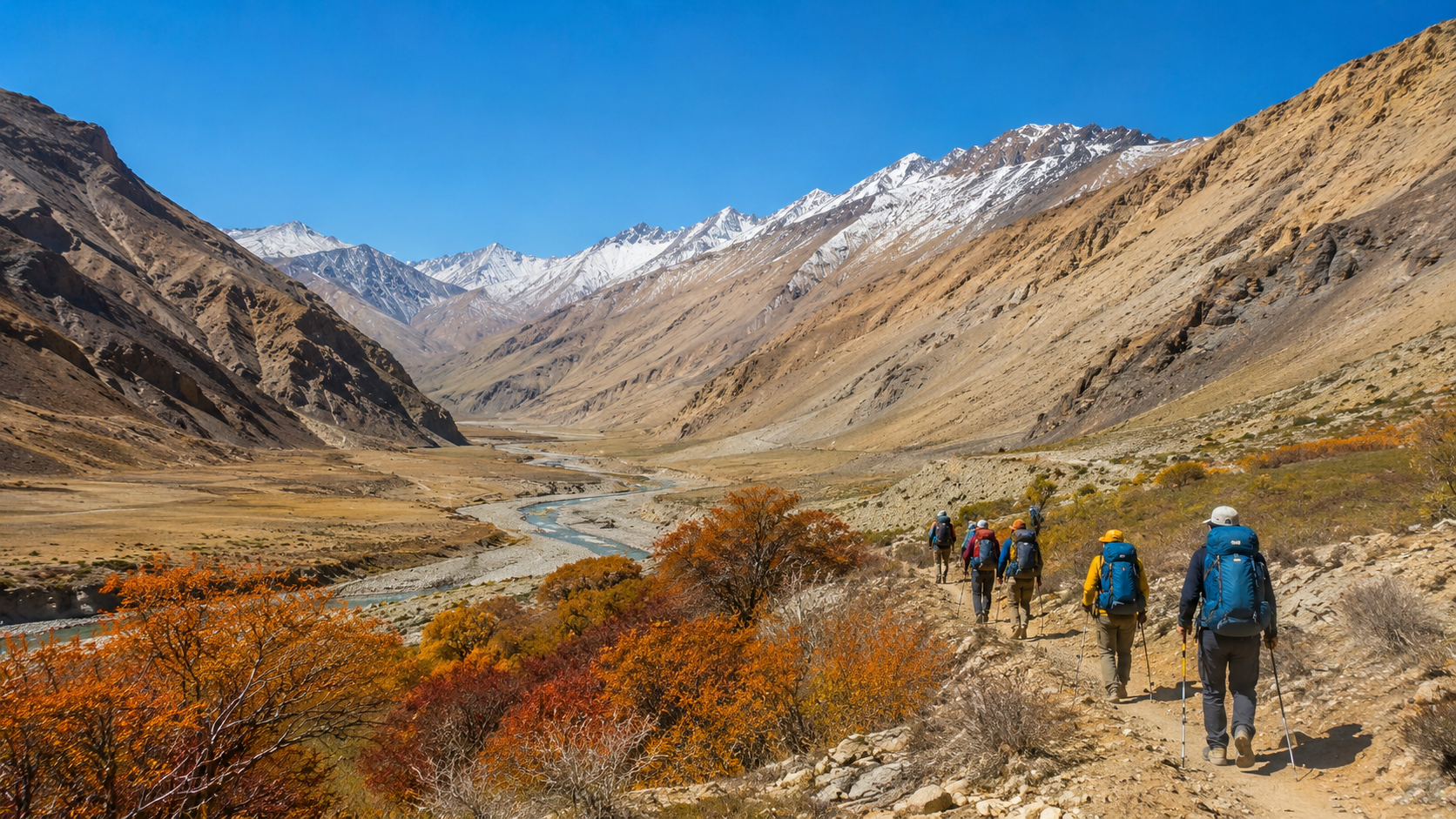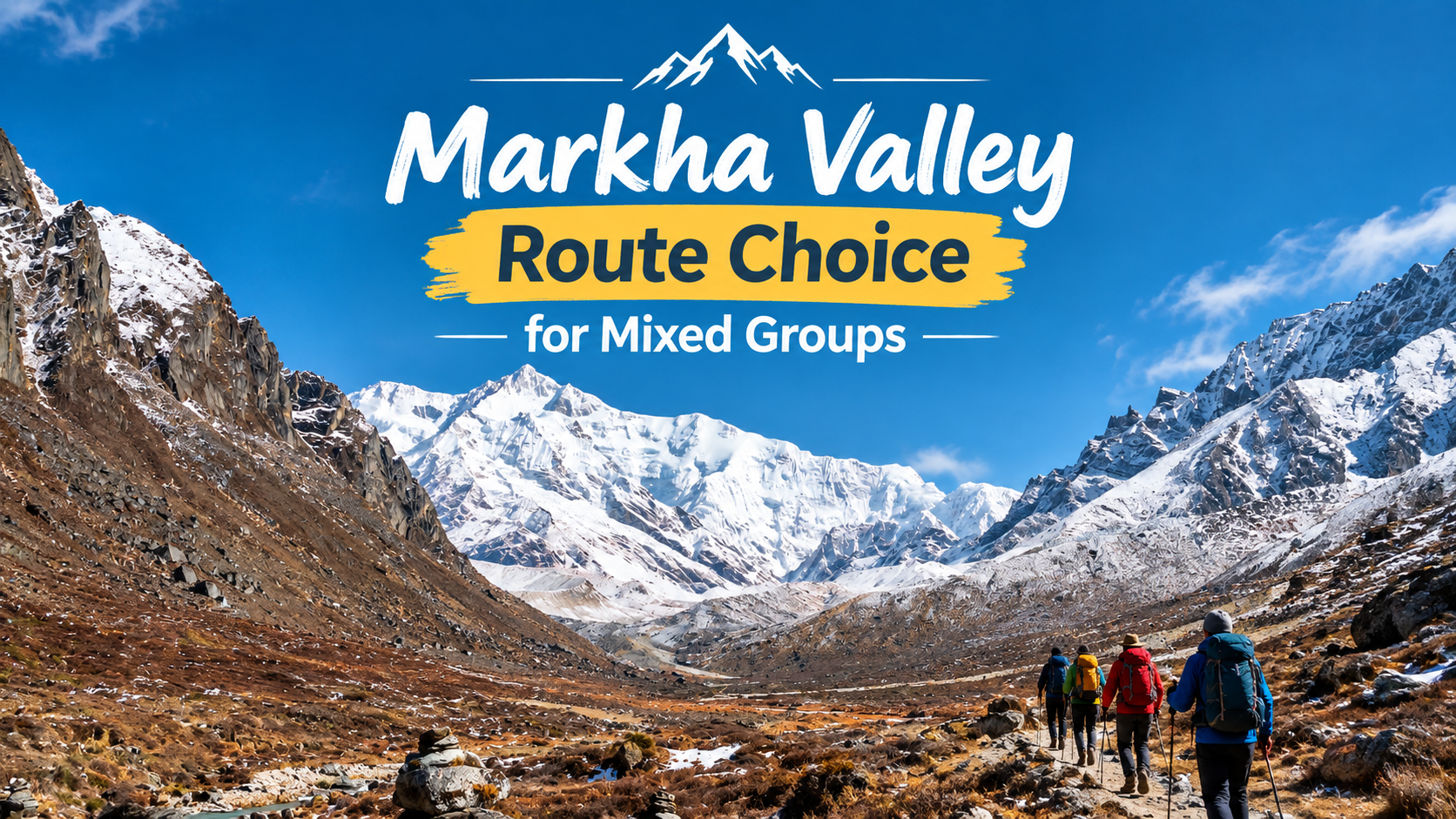
Planning a Markha Valley trek with friends or a partner can be exciting, but a common question comes up when everyone has a different fitness level: Can the whole group stay together on the trail?
The answer depends on how the Markha Valley route, daily walking distances, altitude, rest points and the Kongmaru La Pass day are planned.
A group does not necessarily need everyone to walk at exactly the same speed. In fact, friends with different trekking experience can complete the same trek successfully when the itinerary allows sensible pacing, regular breaks and realistic expectations.
The important thing is to plan the trek around the group’s overall ability rather than the fastest trekker.
For couples, families of adult trekkers, and groups of friends, this approach can make the Markha Valley experience more comfortable and enjoyable.
What Makes Markha Valley Challenging for a Mixed-Fitness Group?
The Markha Valley trek is not simply a matter of walking a fixed number of kilometres every day. Altitude, climbs, descents, terrain, and the length of each trekking day can affect how difficult the route feels.
A person who regularly runs or goes to the gym may still find high-altitude trekking difficult if they have little experience walking for several hours at elevation. Similarly, a slower walker may be able to complete the trek comfortably by maintaining a consistent pace and taking appropriate breaks.
| Factor | Why It Matters for Mixed Groups |
| Walking pace | Faster trekkers may naturally move ahead |
| Altitude | Everyone can respond differently to elevation |
| Ascents | Steep sections can separate the group |
| Descents | They may be tiring even for fit trekkers |
| Rest stops | Regular breaks help the group regroup |
| Pass day | Kongmaru La requires additional planning |
| Trekking experience | Experienced walkers may maintain a steadier pace |
| Daily distance | Long days can be difficult for slower members |
The objective should not be to make every person perform at the same level. Instead, the itinerary should give everyone enough time to complete each section safely and comfortably.
Can Everyone Stay Together on the Markha Valley Trek?
Yes, a mixed-fitness group can stay together on the Markha Valley trek, but the group should be prepared for different walking speeds.
A useful strategy is to establish a group pace. Do not allow the fastest member to determine the day’s schedule.
For example, if one person naturally walks much faster than the others, they can move ahead for a short distance and wait at predetermined rest points. The slower members can then walk without feeling pressured.
This works particularly well when the trek leader or guide has already identified suitable places to regroup.
A practical group system
| Group Member | Recommended Approach |
| Fast trekker | Walk comfortably ahead but regroup at agreed points |
| Average-paced trekker | Maintain the main group pace |
| Slower trekker | Walk steadily without trying to match faster members |
| First-time trekker | Take regular breaks and communicate fatigue early |
| Experienced trekker | Help maintain group coordination |
The most important rule is not to turn the trek into a race.
When one member constantly tries to catch up with the fastest person, they may use more energy than necessary. On a high-altitude trek, conserving energy is often more useful than maintaining a fast pace.
How Should You Choose a Markha Valley Route for a Mixed Group?
Markha Valley route choice for mixed groups should be based on the group’s experience, available time and comfort with altitude rather than simply choosing the shortest itinerary.
There can be different approaches to structuring the trek, and the appropriate route can depend on the starting point, acclimatisation plan and trekking conditions.
For a mixed group, the key questions are:
- How many people are first-time trekkers?
- Has everyone experienced high-altitude trekking before?
- How much time is available?
- Is everyone comfortable with long walking days?
- Does the group want a relaxed experience or a more demanding itinerary?
- How much flexibility is available if someone needs additional rest?
A longer itinerary can sometimes be useful because it gives the group more time to manage its pace instead of compressing the trek into fewer demanding days.
Markha Valley Trek Itinerary for Different Fitness Levels
A Markha Valley trek itinerary should balance walking time with adequate rest and acclimatisation.
Rather than focusing only on distance, consider the nature of each trekking day.
| Trekking Day | What Mixed Groups Should Consider |
| Initial trekking day | Allow everyone to settle into the walking rhythm |
| Valley sections | Use these stretches to maintain a comfortable pace |
| Longer walking day | Schedule enough regrouping and rest |
| Ascending sections | Slower members should not be rushed |
| High-altitude sections | Monitor how everyone is responding |
| Kongmaru La day | Start appropriately and allow sufficient time |
| Descent | Avoid assuming downhill walking will be easy for everyone |
The exact itinerary should be confirmed according to the current route, local conditions and the trek operator’s assessment.
Is a Group Trek in Markha Valley a Good Choice?
A group trek in Markha Valley can work very well for friends and couples, particularly when everyone understands that people may walk at different speeds.
The biggest advantage is that you get the shared experience of travelling through the valley together while having guides and fellow trekkers around you.
However, group trekking requires flexibility.
If one person expects everyone to walk side by side throughout the entire day, differences in fitness can become frustrating. If the group accepts that members may spread out temporarily and regroup at planned locations, the experience can be much smoother.
Group trek vs private trek
| Consideration | Group Trek | Private Trek |
| Pace | Usually follows group schedule | Can be adjusted more easily |
| Cost | Generally shared among participants | Can cost more depending on arrangements |
| Flexibility | Moderate | Higher |
| Mixed fitness levels | Works with cooperation | Easier to customise |
| Rest requirements | Follow group logistics | More adaptable |
| Friends/couples | Good for social experience | Useful when priorities differ |
| Itinerary changes | May be limited | More scope for customisation |
A private arrangement can make more sense when the group has significantly different fitness levels, wants additional flexibility, or needs a more personalised itinerary.
Does Markha Valley Trek Cost Vary for Different Groups?
Yes, the cost of a Markha Valley trek can vary depending on how the trek is organised.
The price is not determined only by the number of trekking days. Accommodation, transport, guide and support staff, permits, meals, group size and itinerary structure can all influence the final cost.
For a mixed-fitness group, an extended or customised itinerary may have different pricing from a standard group departure.
| Cost Factor | Possible Effect on Trek Price |
| Group size | Larger groups may distribute certain costs |
| Private arrangement | May increase per-person cost |
| Trek duration | Additional days can affect overall cost |
| Transport | Starting and ending transfers influence pricing |
| Guide/support team | Depends on group and itinerary requirements |
| Accommodation | Type and location can affect cost |
| Permits | Applicable permits form part of the trek logistics |
| Customisation | Special arrangements may change the package price |
Therefore, instead of choosing a trek only because it has the lowest advertised price, mixed groups should first compare what is included in the itinerary.
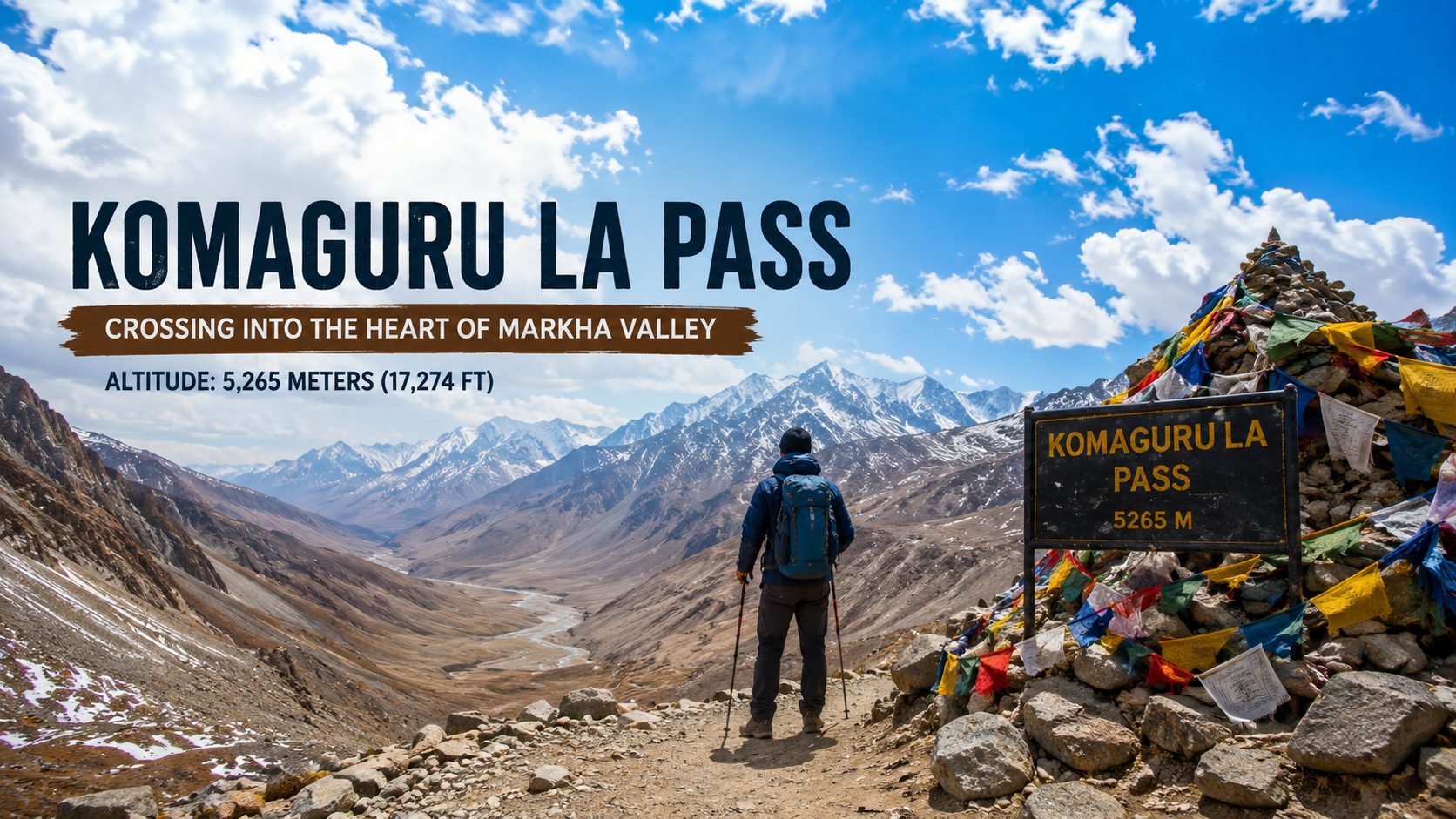
Kongmaru La Pass: The Day Mixed-Fitness Groups Need to Plan Carefully
The Kongmaru La Pass is one of the important high points associated with the Markha Valley trekking experience in Ladakh.
For a mixed-fitness group, the pass day deserves particular attention because it can involve sustained climbing at high altitude followed by descent.
This is where the difference between general fitness and trekking fitness becomes particularly noticeable.
Someone who is comfortable walking on flat ground may still need more time on a high-altitude ascent.
How should the group handle pass day?
Start with a realistic pace. The fastest member should not set the pace for everyone.
Take planned breaks. Short, regular breaks can be more useful than waiting until someone becomes exhausted.
Carry appropriate layers and essentials. Weather and temperature can change quickly at altitude.
Stay in communication. A member who is struggling should communicate early rather than trying to hide fatigue.
Allow enough time. A pass day should not be planned as though every trekker will finish at the same speed.
The exact conditions at Kongmaru La can vary, so route and itinerary decisions should be made with the guide’s current assessment.
What If One Person in the Group Is Much Slower?
This is one of the most common concerns among friends planning a trek together.
The solution is not necessarily to leave the slower trekker behind or force them to walk faster.
Instead, divide the day into natural meeting points.
For example:
Fast group → Walk ahead → Wait at agreed point → Main group arrives → Rest together → Continue
This creates a balance between different walking speeds without breaking the group experience.
The slower trekker should also avoid comparing their pace with someone who has considerably more trekking experience.
On a high-altitude route, steady movement is generally more sustainable than repeatedly speeding up and stopping.
What Should Couples Consider on a Markha Valley Trek?
Couples often have a slightly different challenge from larger groups: one person may be significantly fitter than the other.
If the stronger trekker constantly walks ahead, the slower partner may feel pressured. On the other hand, asking the faster person to remain at a very slow pace for the entire trek may also affect their experience.
A planned approach works better.
Discuss the expected pace before starting the trek, decide where you will regroup, and agree that either person can request a break when needed.
If the fitness difference is substantial, a private Markha Valley trek itinerary can provide more flexibility in planning the walking day.
How to Prepare for Markha Valley With Different Fitness Levels
Preparation does not mean everyone needs to follow the same training programme.
Instead, each person should prepare according to their current fitness and trekking experience.
| Preparation Area | What to Practise |
| Walking endurance | Longer walks over several weeks |
| Leg strength | Squats, lunges and controlled stair work |
| Uphill ability | Incline walking or stair climbing |
| Backpack walking | Gradually practise with a suitable load |
| Recovery | Include rest between harder sessions |
| Footwear | Use trekking shoes before the trek |
| Hydration | Practise regular hydration during longer walks |
It is also useful to avoid making the first long-distance hike of your preparation period immediately before the trek.
Consistency is more useful than one extremely difficult training session.
Route Planning Matters More Than Walking Speed
For a mixed-fitness group, route planning can be as important as physical preparation.
A well-structured itinerary should consider:
- Daily walking distance
- Elevation changes
- High-altitude sections
- Rest opportunities
- Accommodation availability
- Weather and trail conditions
- The group’s overall trekking experience
This is why copying another trekker’s itinerary is not always appropriate.
Two groups can complete the same Markha Valley route but need different pacing and rest strategies.
When Does a Private Markha Valley Trek Make More Sense?
A private trek may be worth considering when:
- The group has a large difference in fitness levels.
- Some members are first-time high-altitude trekkers.
- The group wants additional rest flexibility.
- You want to customise the walking schedule.
- Friends or couples want to travel together without adjusting to an unrelated group.
- You want more control over the itinerary.
This does not mean a standard group trek cannot work. It simply means private arrangements may provide more flexibility when the group’s requirements are unusual.
Markha Valley Mixed-Fitness Group Checklist
Before booking, discuss these questions together:
| Question | Why It Matters |
| Can everyone walk for several hours? | Helps establish realistic expectations |
| Does anyone have high-altitude trekking experience? | Experience can affect pacing and confidence |
| Are fitness levels significantly different? | May influence route planning |
| Is everyone comfortable with the pass day? | Kongmaru La requires careful planning |
| Can the group add an extra day if necessary? | Provides greater itinerary flexibility |
| Does everyone agree with the expected pace? | Prevents unnecessary pressure |
| Would a private trek be useful? | Important for highly uneven groups |
A few minutes of planning before the trek can prevent disagreements on the trail.
Why Choose Glacier Treks & Adventure for Your Markha Valley Trek?
At Glacier Treks & Adventure, trek planning is approached around the practical requirements of the group rather than treating every trekker as having identical fitness and experience.
For friends and couples considering the Markha Valley trek, the team can help discuss itinerary structure, pacing, route requirements, pass-day planning and the suitability of group or private arrangements.
The focus should be on creating a trekking plan where participants understand the physical requirements before departure and can prepare accordingly.
Why trekkers can consider us
- Local trekking experience and route knowledge
- Guidance for itinerary planning
- Support for group and private trekking arrangements
- Practical discussion of fitness and trekking expectations
- Focus on responsible high-altitude trekking
For the most suitable itinerary, discuss your group’s size, trekking experience, preferred dates and fitness differences before booking.
Frequently Asked Questions About Markha Valley for Mixed-Fitness Groups
Can people with different fitness levels do the Markha Valley trek together?
Yes. People with different fitness levels can trek together if the itinerary, pace and rest strategy are planned realistically. The group does not need to walk at exactly the same speed throughout the day.
Is Markha Valley suitable for first-time trekkers?
Suitability depends on the individual’s fitness, trekking experience, preparation and ability to handle high-altitude conditions. First-time trekkers should understand the demands of the route before booking.
Is a group trek in Markha Valley better for friends?
A group trek can be a good option for friends who are comfortable following a shared itinerary. If fitness levels vary considerably, a private arrangement may provide more flexibility.
Does Markha Valley trek cost change with group size?
The total and per-person cost can vary according to group size, itinerary, accommodation, transport, support staff and whether the trek is private or part of a fixed group departure.
Which route is suitable for mixed-fitness groups?
There is no single route that is automatically suitable for every mixed-fitness group. The appropriate route and itinerary depend on fitness, experience, available time, acclimatisation requirements and current trail conditions.
Is Kongmaru La difficult for slower trekkers?
The pass day can be demanding because of altitude and ascent. Slower trekkers should maintain a comfortable pace, take appropriate breaks and follow the guide’s instructions rather than trying to match faster members.
Should we choose a private Markha Valley trek?
A private trek can be useful when the group has significantly different fitness levels or wants greater control over pacing and rest. The decision should depend on the group’s specific requirements and budget.
How can friends stay together when they walk at different speeds?
Agree on a comfortable group pace and predetermined regrouping points. Faster trekkers can move ahead temporarily while waiting at agreed locations instead of continuously forcing slower members to increase their speed.
Related Markha Valley Trek Resources
Markha Valley Trek Guide
Planning your first Markha Valley adventure? Read our detailed Markha Valley Trek Guide for information about the route, itinerary, preparation and key trekking considerations.
Read More: Markha Valley Trek Guide
Ladakh Trek Complete Guide
If you are comparing trekking options across the region, our Ladakh Trek Complete Guide provides a broader starting point for understanding trekking routes, preparation and planning considerations.
Read More: Ladakh Trek Complete Guide
Plan Your Markha Valley Trek
Book the Goechala Trek now: ₹40,000 per person · Call/WhatsApp +91 74072 48200 · Email kiran.yuksom@gmail.com
Different fitness levels do not automatically mean a group has to split up.
The better approach is to plan around realistic pacing, suitable rest points, route selection and the group’s overall expectations. The Markha Valley trek itinerary should account for the fact that the strongest trekker and the least experienced trekker may not move at the same speed.
For friends and couples, the goal should be to enjoy the route together without turning every trekking day into a competition.
If your group has different fitness levels, discuss the expected pace, Kongmaru La Pass day, available time and whether a group or private arrangement is more appropriate before finalising the trek.